Tuesday, April 17, 2012

Psycho (1960)


Genre: Horror, Mystery, Thriller

Released: August 10, 1960


My Rating: starstarstarhalf
(Click here for more info on my rating scale)


            Psycho is a good, memorable film.  I don't love it, but I do like it; it's a good piece of cinema and is notable for many things.  First of all, the black-and-white cinematography is good, and it really contributes to the tone and mood of the film.  There are several great camera shots and sequences.  The music is good too, and it also contributes to the tone of the film, probably even more so than the cinematography.  Finally, and probably most importantly, the film is noteworthy for its storytelling.  Alfred Hitchcock broke several Hollywood cinema traditions of the time, and created a film that contains elements that can be easily recycled, yet at the same time is very unique, and is a good mystery horror thriller.
            The story starts off with Marion Craine, an office worker in Phoenix who desperately wants to be with her lover.  When her employer entrusts Marion to bank $40,000, Marion leaves town, steals the money, and goes on the lam.  Along the way, she encounters a used car salesman and a policeman, who notice her somewhat nervous behavior, which she is not good at hiding.  Eventually, tired of her long drive and caught in a storm, she exits the main highway and pulls into the out-of-the-way Bates Motel to spend the night.  The motel is run by a young man called Norman Bates, who seems to be dominated by his twisted mother.  Events of the night change the course of the film afterwards starting, with an excellent and unforgettable sequence in which Marion is murdered in her shower, and her journey, therefore, comes to an end.  Soon after, others come to the motel searching for Marion, including Loomis, private investigator Arbogast, and Marion's sister.  They make shocking discoveries.
            The story isn't all that great, but what makes it good and involving is the way it develops and unfolds.  There are a lot of aspects of the movie that are not so special, and ones that have been used again and again over the years.  There are some things about the movie that seem cliché, and possibly a bit cheesy.  However, despite all this, after all these years, Psycho still has a uniqueness that is memorable and ultimately not copied to this day.  Like I said, it's not the most extraordinary story, but it's structured in a great way.  It tampers with some traditional narrative elements.  It starts out seemingly normal in terms of narrative.  Then, we are shocked at the movie's midpoint as Marion, our protagonist for the first half of the movie, is killed, and the course of the film is drastically changed, and what follows is a series of (like I said before) shocking discoveries and twists.  The audience's expectations keep being flouted, especially in the second half of the film, especially in two major ones, the second of which I won't spoil for those who haven't seen the film.  It doensn't have great story or character complexity, but yes, it's strong.
            The stark black-and-white cinematography used in the film is very good, and even further contributes the the tone of the film.  Also, by far one of the most important aspects of the film is the music.  Bernard Herrmann composed an excellent score for the film.  The film works fine with its narrative alone, but the music really brings it all to life and supports everything.  The music consisted of all string instruments, and the music is consistently dissonant and tense.  The music, like everything else about the film, can be easily recycled in movies, but, like I said before, Psycho still has a level of uniqueness that really can't be matched.
            Overall, it's an important landmark in the history of cinema, and it's still a good film, even to this day - not at a four-star level, but still very good.  I found it to be a very good movie experience.  If you haven't seen it, I recommend you do.

Cast and Credits:
Norman Bates: Anthony Perkins
Marion Crane: Janet Leigh
Lila Crane: Vera Miles
John Gavin: Sam Loomis
Det. Milton Arbogast: Martin Balsam

Directed by Alfred Hitchcock
Black and White
Approx. 109 minutes

Tuesday, March 27, 2012

Citizen Kane (1941)


Genre: Drama, Mystery

Released: September 5, 1941


My Rating:  starstarstarstar
(Click here for more info on my rating scale)


I wouldn't call Citizen Kane the greatest movie ever made, but, even to this day, it's definitely a great piece of cinema and a wonderful example of storytelling.


Citizen Kane has been lauded the best film ever made by many people.  Do I particularly agree?  No.  But nonetheless, I think it is a great movie.  It has some of the dated characteristics of cinema of it's period, the 1940's, but a lot of it's characteristics are still strong nowadays.  I understand that the plot has some parallels to the real life story of William Randolph Hearst, but I don't know all that much about him, so I'm going to talk about only the film, which is great itself.  The film is an important figure in the history of cinema, technologically and in terms of storytelling.

The story is really not all that complicated, but the way it unfolds is great and engaging, and almost makes it seem complex, and it's told from a number of perspectives.  The film opens up with the death of Charles Foster Kane (Orson Welles), the owner of the Inquirer, a New York newspaper.  Just before dying, Kane utters the word "Rosebud".  Then an approximately ten minute long newsreel summarizes the story of Kane, representing the public's view of him, and an overview of the story.  Then, for the rest of the film, we are shown more details and depth of the story via flashbacks as news reporters go around and obtain information about Kane and his life.

For those of you who haven't seen the film, I won't fully spoil it for you.  I'll just give an overview.  Kane achieved success and rose to power, but eventually suffered a major blow to his reputation, and he crashed.  Along the way, he even gets married and divorced twice.  With the aid of his closest friend, Jedediah Leland (Joseph Cotten), Kane starts builds a nationwide newspaper empire.  He is ruthless as he achieves this, yet generous at the same time in a few ways, such as being willing to lose a million dollars a year to gain more newspaper circulation.  Eventually, he runs for a political position, but his success to this is lost as his rival uncovers his affair with a "singer", and after this, his reputation is destroyed and his life's success declines.  There is more to the story, but, like I said, I'm only giving a summary; I'm not giving the full story away, for those of you who haven't seen the film.

All the while, we, the audience, and the reporters in the film, wonder who Kane really was, not just the story of the events of his life, from his rise to his fall, but who he really was underneath.  They believe that a key to finding this out lies in his dying word, "Rosebud".  At one point in the film, a reporter, Thompson, says, about the word, "Maybe Rosebud was something he couldn't get, or something he lost."  At another point, someone (I don't remember who) says, "I don't think one word can describe one man's life".  The entire movie is a puzzle, a puzzle of Kane's life, and not just that, but of who he really was (for lack of a better, deeper term).  "Rosebud" is just one piece, a missing piece, of that puzzle, but it may be an important piece.  Although, then again, maybe not.  We do eventually find out what the word represents and what its origin is, and it represents one of the important messages of the movie, but I won't spoil it for, again, those of you who haven't seen the film.

The film is great in terms of its storytelling.  In addition to its storytelling, the film is also an important point in cinema in terms of a few other factors, such as cinematograpy.  One of the most striking of the cinematographic effects is ths stark contrast between brightness and darkness.  Also notable are the camera angles - which create many unique shots throughout the film - and the use of deep focus, enabling images both in the back ground and the foreground to stay clear in focus.  I also liked the music score.  Bernard Herrmann, who also composed the score for Psycho (1960), created an effective score with very good combinations and uses of harmony, orchestration, melody, and other musical elements, and really supports the drama and moods of the film.

So, in summary, while I personally don't think Citizen Kane is the best film ever made, I did find it to be great.  Watching it was a very good experience for me.  It's great in terms of storytelling and technical aspects, and, overall, like I've said, it's a great piece of cinema, and an important landmark in cinema history.

Cast and Credits:
Charles Foster Kane: Orson Welles
Jedediah Leland: Joseph Cotten
Susan Alexander: Dorothy Comingore
Walter Parks Thatcher: George Coulouris
Jim Geddes: Ray Collins
Mrs. Kane: Anges Moorehead
Emily Norton: Ruth Warric

Directed by Orson Welles
Black and White
Approx. 120 minutes

No MPAA rating.

Thursday, March 22, 2012

John Carter (2012)


Genre: Action, Adventure, Fantasy, Sci-Fi

Released: February 9, 2012


My Rating:  starstarstar
(Click here for more info on my rating scale)


Overall, in my opinion, John Carter is basically a two-and-a-half star film, but it hits enough high notes and sustains enough energy along the way to be enjoyable as a sci-fi blockbuster and scrape a three star rating from me.


            I saw John Carter in the theater on Friday, March 14.  I've never read the books that the movie is based on, but based on the reviews I've skimmed, I had pretty low expectations for the film.  And a lot of the negative aspects I sort of expected of the film were confirmed.  Overall, I didn't like the film, but I did sort of enjoy it a little, sort of as a guilty pleasure, almost.  The CGI is great, and very convincing, and I enjoyed the visual experience.  As for the story and other important aspects, the film is a bit weak.  There are many flaws in the film; there's no denying that.  The story is derivative, and it suffers from a somewhat sloppy and slightly convoluted plot.  Overall, in my opinion, it's basically a two-and-a-half star film, but it hits enough high notes and sustains enough energy along the way to be enjoyable as a sci-fi blockbuster and scrape a three star rating from me.
            The movie is about John Carter, a Civil War veteran who is trying to lead a normal life.  He is locked up for refusing to join the Army, but he escapes and is pursued.  After a bit of action, he hides in a cave, in which he encounters someone holding a medallion.  When Carter touches the medallion, he is transported to Mars, where the lower gravity enables him to leap incredible heights.  His first encounter with the natives are with the tall, green-skinned, four-armed, horned Thorks.  Soon, he ends up rescuing a princess, Dejah Thoris, of another native group on the planet called the "red" humanoids, and he soon learns of the civil war going on between that group and the other group, the "blue" humanoids.
            The director, Andrew Stanton, has previously directed animated films, such as Finding Nemo and Wall-E, and this is his first live-action movie, which may have contributed to the flaws in the movie.  Like I said, the movie is very flawed.  It's somewhat sloppy, and a bit confusing at times, and not fully coherent (but it's not incoherent).  The progression of the story and the interrelation and connection of everything in it doesn't completely fit, and is not really how it should have been.  A few things actually felt to me like they were almost thrown together.  And in a few ways, it felt almost like a cartoon.  However, the movie does maintain acceptable coherency, etc., and it maintains a level of energy that kept me at least somewhat entertained; surprisingly, I never got bored during this movie.  The movie is a bit confusing at times, and there are a few twists, and I had a bit of trouble keeping track of some names and stuff, but it doesn't really matter, because it's pretty easy to understand the overall plot.  In fact, I actually left the theater at one point to go to the restroom, and I came back three minutes later, but it didn't matter because it was pretty easy for me to pick up on what was basically happening.
            There are some positive things that I can say about the movie.  The visuals are great, and everything in the movie is very well portrayed with the CGI, and in pretty good detail.  The movie introduces a new cultre/world/etc., although it doesn't stand out as a character within itself, like the new world in Avatar did.  But it's still pretty nice.  I also liked the ships; they were very well designed.  In fact, all the special effects were good.  Dejah Thoris is very pretty, and she's a highlight of the movie.  I liked the cast of the movie, especially Taylor Kitsch and Lynn Collins.  I also somewhat liked the music score.  The story, plot, progression, development, and pacing all needed to be much better.
            Overall, I didn't like the movie or anything, but it was better than I thought it would be.  I found it a bit enjoyable, although I would definitely not recommend it for any awards or special recognition or anything.  If fact, I wouldn't be surprised if this movie is forgotten in the near future.  In my opinion, it's basically a two-and-a-half star movie, but it does hit enough high notes to be a bit enjoyable as a sci-fi blockbuster and to scrape (although barely) a three star rating from me.  Although, it's not a movie that I could really watch over and over again; once was really enough for me.


Cast and Credits:
John Carter: Taylor Kitsch
Dejah Thoris: Lynn Collins
Sola: Samantha Morton
Tars Tarkas: Willem Dafoe
Tal Hajus: Thomas Haden Church
Matai Shang: Mark Strong
Tardos Mors: Ciaran Hinds
Sab Than: Dominic West
Edgar Rice Burroughs: Daryl Sabara

Walt Disney Pictures presents
A film directed by Andrew Stanton
Based on the Edgar Rice Burroughs novels

Rated PG-13 for intense sequences of violence and action

Wednesday, February 22, 2012

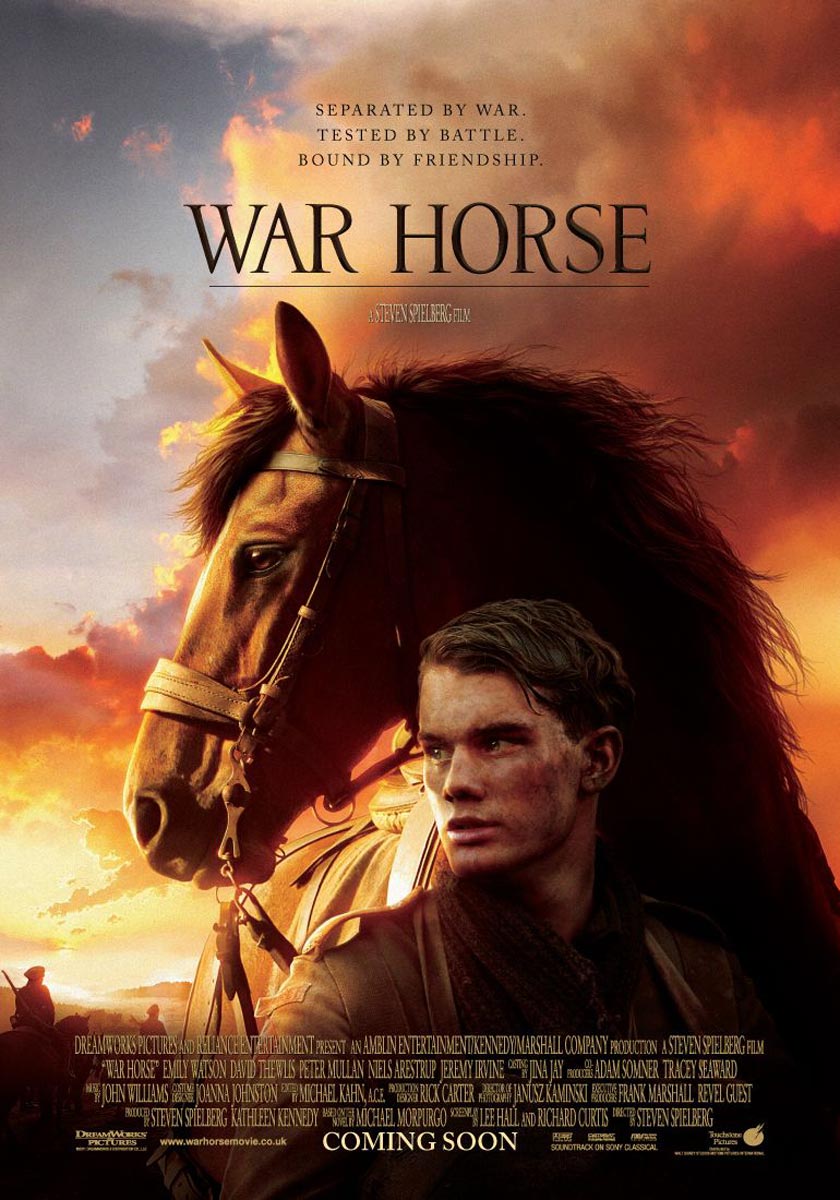
War Horse (2011)

Genre: Drama, History, War

Release Date: December 25, 2011

My Rating:  starstarstarstar
 (click here for more info on my rating scale)


 War Horse is entertainment for the heart and soul, and, in my opinion, it's definitely one of Spielberg’s best films to date.


I rarely go to the theater.  However, in January, I went go see War Horse in the theater.  I bought my ticket and a soda, and I walked into the theater, and sat down in the back row towards the middle.  I’ve never read the book that the movie is based on, but I was hoping to like the movie, and I ended up loving it.  Steven Spielberg has released some good movies in the past; Indiana Jones (the original trilogy; the fourth was a bit weak), Jurassic Park, Schindler’s List – just to name a few.  He has declined a bit during the past few years.  Now, he’s risen back up triumphantly with War HorseWar Horse is entertainment for the heart and soul, and, in my opinion, definitely one of Spielberg’s best films to date.


War Horse is the story of an elegant brown stallion, set during the time of World War I.  A farmer buys this horse, and his son, Albert Narracott (Jeremy Irvine), calls him Joey.  Albert raises, trains, and develops a strong friendship with the horse.  However, as WWI starts, Joey is sold into cavalry.  At this point, Albert is too young to enlist in the army and therefore stay with Joey, so for a while, the movie focuses only on the experiences of the horse, in and out of the line of battle.  Will they be reunited?  (I think you know the answer to that – the movie is pretty predictable.)  I won’t give away anything else about the story, but there are emotions, tears, etc. (even a few laughs here and there) throughout the film.

The story is not original, and it’s pretty clichéd and predictable.  However, it works very well.  I personally found it overall to be interesting, entertaining, gripping, and emotional.  The first forty-five minutes or so of the film are a bit slow, and it’s the weakest part of the film.  However, like I said, it does establish the essential relationships we need for the rest of the movie, particularly between Albert and Joey.  After this first act ends and the second act begins, things start picking up – pace emotion, etc. – and it gets much better.  John Williams has returned along with Spielberg, and has composed a very good score for the movie, as he always does.

Visually, the film is amazing, too.  The cinematography and visual and special effects are very good, and really contribute to the emotion and tone of the film.  The landscapes are very good, and so are the war effects.  There are some action scenes that get pretty violent and gory, and the effects are really good here too, but it's still not extreme enough to go above a PG-13 rating (I'm not saying that's a bad thing, though).  A couple of particular noteworthy examples of the great visuals are the opening and closing shots, especially the latter.  And like I said above, these visuals really contribute strongly to the emotion, narrative, and tone of the film.

Overall, I really enjoyed this film.  I'm glad I saw it in the theater.  Despite its predictability and unoriginality (for which it gets quite a bit of hate on IMDb), I really found the story to be compelling and emotional.  Personally, I don't think a movie has to be original to be good, as long as it's structured well, properly paced, and has sufficient heart, character, story, and emotion to make it a worthwile experience.  The best case is when a movie touchs my heart and soul in some way.  A good example is The Shawshank Redemption - predictable and unoriginal, yet it really touched my heart and soul, and I found the story compelling, and I loved the movie.  Ultimately, whether or not a movie is good is a matter of personal opinion, not fact.  For me, personally, I have to personally have a positive overall experience.  This movie meets all these criteria well, at least for me.  War Horse touched my heart and soul very strongly.


DreamWorks and Touchstone present
A film directed by Steven Spielberg
Based on the novel by Michael Morpurgo
Music by John Williams

Rated PG-13 for intense sequences of war violence

Monday, December 5, 2011

Titanic (1997)


Genre: Adventure, Drama, History, Romance

Released: December 19, 1997

My Rating:  starstarstarstar
(Click here for more info on my rating scale)


With lots of heart, suspense, drama, and great historical portrayal combined with fiction and stunningly realistic visual and special effects, James Cameron’s Titanic is arguably the best film of 1997.


James Cameron’s Titanic is proof that a movie doesn’t have to be original to be good.  I’m not saying that originality is bad; I like it, it’s good, but it’s a minor factor in how good a movie/story is.  The story doesn’t necessarily have to be original, but it has to be compelling to people; has to capture the emotion and interest of the audience and keep them riveted throughout.  Titanic does just that.  We all pretty much know what’s going to happen during the movie, but the story is still compelling, the storytelling is excellently done, and the tone of the film is great.  The story captures the emotion, heart, and interest of the viewer and keeps it completely riveted all the way through the end (it did for many people, anyway, including me).

Titanic combines fiction with non-fiction, the more important of which is probably the non-fiction aspect: the tragic sinking of the luxury cruiser R. M. S. Titanic in 1912.  There have been a few films that portrayed the tragic event (such as Titanic in 1953 and A Night To Remember in 1958).  Then, in 1997, along came James Cameron, who, despite some weaknesses with script and dialogue, is good at storytelling, and always pushes the advancement of visual and special effects, and uses them to his advantage.  Therefore, a film about the Titanic was a perfect project for him.  The visual and special effects in the film are very good.  The recreation of the ship (with both physical sets and computer effects) is great, with excellent detail and scope.  Except for a few brief moments here and there when the special effects falter a bit and something doesn’t look quite real, it’s it looks spellbindingly realistic, and, while watching it, it felt almost like I was really there.  James Cameron really spent his $200 million budget wisely.

Some of that money also went into filming some footage of the actual wreck at the bottom of the ocean.  This footage is seen in a scene at the beginning of the movie, shot via a remote-controlled underwater camera.  As Roger Ebert says, “These shots strike precisely the right note; the ship calls from its grave for its story to be told.”  However, instead of only telling a story of only the real event, he also weaves a fictional story ingeniously into it, specifically an almost Romeo and Juliet-like story of forbidden love.  In modern times (actually, during the time the film was made), a fictitious survivor of the Titanic sinking, old Rose DeWitt Bukater (Gloria Stuart), tells the story via flashback, and tells about her brief yet intense forbidden love affair with Jack Dawson (Leonardo DiCaprio).

Rose (Kate Winslett) was seventeen at the time she was on the Titanic, and she came from a wealthy upper-class background.  She is betrothed to a rich snob, Cal Hockley (Billy Zane).  She hates this, and is extremely miserable.  Meanwhile, Jack is on the opposite end of the class spectrum.  He is basically poor, and he wins a ticket to the Titanic in a lucky win in a card game.  He eventually finds Rose, who is about to commit suicide by jumping off the ship, and he saves her life.  What follows is the development of their forbidden love story, which is told in such a way that shows off different parts of the magnificent cruise ship.  It’s a simple, predictable, and clichéd story, but it’s still very compelling, especially since we know how that the ship is going to sink eventually and cause heartbreaking results on their romance (predictability is actually good here).

Meanwhile, there is the subplot regarding the actual historical events leading up to the sinking - the arrogance of the builders and the people who ran the ship (they thought the ship was unsinkable).  At the midpoint of the movie, the ship hits the iceberg, and the second half of the movie begins, and develops into a thrilling yet tense and dramatic race for survival.  The entire movie, from start to finish, is handled extremely well in terms of story, and is completely full of heart and soul; it’s all very strong in emotion.  And yes, it’s predictable, but in this case it actually adds to the power of the movie.  But it’s not completely predictable.  There are a lot of things that are not fully given away, like exactly who dies (besides Jack) and who lives (besides Rose), and some other things along the way, too.

Some people would definitely argue that the love story between Jack and Rose is completely unnecessary, but it actually helps the movie.  It adds more emotion to the story and makes it that much more compelling.  It also provides more structure to the story and the showing-off of the ship, and even allows the audience to really connect with the passengers on the ship (innocent people whose lives are ultimately ruined or permanently altered as a result of the builders’ arrogance and ignorance – unsinkable, yeah right).  And the special effects also made the film work well, too.  However, despite having great special effects in his film, James Cameron did not lose sight of what’s truly important – story, characters, emotion, etc.  The movie does not rely on special effects.  It wouldn’t have worked nearly as well without them, but, as in any exceptionally good film, they are not the main driving force of the film.

If I had to criticize one thing about the film, it would be the length.  In my opinion, it’s too long, at three hours and fifteen minutes.  However, it still works brilliantly as it is.  Every moment of the story serves a great and important contribution to the story, the drama, the emotion, and everything else.  The performances by the actors were very good, the pacing of the film is great (if a bit lengthy at times), and the tone of the film is great.  James Horner’s score is fantastic, very memorable, absolutely beautiful, and perfect for the film.  And, despite having a good deal of fiction in it, the movie excellently portrays the historical tragic sinking of the Titanic, and captures the horror and tragedy brilliantly.  With lots of heart, suspense, drama, and great historical portrayal combined with fiction and stunningly realistic visual and special effects, James Cameron’s Titanic is arguably the best film of 1997.


Cast and Crew:
Jack Dawson: Leonardo DiCaprio
Rose DeWitt Bukater: Kate Winslett
Cal Hockley: Billy Zane
Molly Brown: Kathy Bates
Ruth DeWitt Bukater: Frances Fisher
Captain Smith: Bernard Hill
Old Rose: Gloria Stuart
Brock Lovett: Bill Paxton

Paramount Pictures and Twentieth century pictures present
A Lightstorm Entertainment production of
A film written and directed by James Cameron
Music by James Horner
Running time: 194 min.

Rated PG-13 for disaster related peril and violence, nudity, sensuality and brief language

Tuesday, August 23, 2011

Harry Potter and the Deathly Hallows: Part 1 (2010)


Genre: Action, Adventure, Drama, Fantasy, Mystery

Release Date: November 19, 2010


My Rating: starstarstarhalf    (Click here for more info on my rating scale)


            This is it, the beginning of the end.  I remember buying and reading the seventh book when it was released (around the time the fifth movie came out), and I loved it.  Now it has finally come to the screen, split up into two movies.  It may seem like it’s getting split into two movies to make a little extra cash, but after seeing the movies myself, I see that’s not the case.  The “Deathly Hallows” story is really two big and complex to be fit into one two-and-a-half hour movie.  With the story split up, there is a lot more room for story and character development, among other good things.  I saw “Harry Potter and the Deathly Hallows: Part 1” in the theater during Thanksgiving weekend last year (2010).  I have to say, I was pretty impressed.
            The movie covers the first two thirds – the first and second acts – of “Harry Potter and the Deathly Hallows.”  In the previous six films, there has been a major story constantly developing.  However, each individual installment has stuck to more or less a standard formula: stuff happens before Harry goes to Howgwarts, then Harry and his friends go to Hogwarts, new teachers are introduced, we see a few classes, some story is developing all the while, eventually climaxes, etc.  There have been different twists and turns in each of the individual stories, each getting more and more drastic, but they’ve had that very basic formula underlying deep underneath.  Wow, I am a horrible explainer sometimes, but I think you can definitely tell what I’m saying and agree with it.  In this installment, Deathly Hallows Part 1,” the story has taken a drastically different turn.  In fact, Hogwarts is not in this particular installment at all.  Then when it comes back in Part 2, it’s nothing like we’ve seen it before, and a totally different plot formula even there.  Also, Harry and his friends are now young adults, as opposed to the eleven-year-old kids they were back at the beginning of the long story.  Back then, it was a young light-hearted story, and it has now grown into a deep, dark, mature story suitable for all ages (and Harry Potter is also a story about growing up).
            Harry begins to prepare to leave his familiar life behind and to go on his adventure (with Hermione and Ron, of course) to find and destroy the horcruxes.  However, Voldemort and his followers, the Death Eaters, conquer and take over the Ministry of Magic, and all chaos breaks loose as Voldemort begins to terrorize the wizarding world, and even the non-magic world.  Harry is forced to flee along with Hermione and Ron, and he begins his long and dangerous race against time and the Dark Lord to find and destroy all the horcruxes.  There is also one more thing: there are these three objects called the Deathly Hallows that Harry eventually learns about, and which he must find in order to obtain the power necessary to defeat the Dark Lord once and for all.
             Director David Yates directed the Harry Potter films from the fifth all the way to the end.  The fifth movie was okay, but I felt that David Yates had taken a step in the wrong direction in many ways.  The sixth film (Half-Blood Prince) was a little better, and David Yates seemed to be improving.  However, he was still doing some things with the moive that I wasn’t really impressed with, and he didn’t have quite the right tone.  Therefore, I was a bit unsure whether or not the seventh film would have the tone and intensity it needed.  It did.  David Yates finally knew what he is doing, and he delivered the first part of the final chapter well.
The film has just the right combination of action, adventure, suspense, drama, emotion, character development, and everything else.  I was especially impressed with the action scenes.  The action scenes in the Half-Blood Prince were a bit dry, but the action sequences in this film actually had high-energy action, which would increase drastically in “Harry Potter and the Deathly Hallows: Part 2.”  Also, this being only the first two-thirds of the story, David Yates and Steve Kloves structured the film’s plot very well, and it actually climaxed pretty well, while also leaving a giant cliffhanger for Part 2.  The film doesn’t zip by quickly in it’s long length like Part 2 does, but the pacing is very good, the fluidity is good, and the movie is not boring.  It does not slog at all (yes, Peter Travers – Rolling Stone – I’m talking to you).  It leads well into the last film, and is a good beginning to the end of the great ten-year-old Harry Potter saga.


Cast and Credits:
Harry Potter: Daniel Radcliffe
Hermione Granger: Emma Watson
Ron Weasley: Rupert Grint
Lord Voldemort: Ralph Fiennes
Bellatrix Lestrange: Helena Bonham Carter
Draco Malfoy: Tom Felton
Lucius Malfoy: Jason Isaacs
Rufus Scrimgeour: Bill Nighy
Ginny Weasley: Bonnie Wrighty
Molly Weasley: Julie Walters
Vernon Dursley: Richard Griffiths
Severus Snape: Alan Rickman

Warner Brothers Pictures presents
A film directed by David Yates
Screenplay by Steve Kloves
Based on the novel by J. K. Rowling
Music by Alexandre Desplat
Running time: 146 min.

Rated PG-13 for some sequences of intense action violence, frightening images and brief sensuality

Saturday, August 6, 2011

Cowboys & Aliens (2011)


Genre: Action, Adventure, Sci-Fi, Thriller, Western

Release Date:  July 29, 2011

My Rating:  starstarstar     (Click here for more info on my rating scale)


Moviegoers who go to see “Cowboys & Aliens” get just what they expect: cowboys and aliens.  It is weird, dorky, ridiculous, stupid, and noisy, and it’s kind of fun.  It has just about every cinematic cliché possible, but that isn’t necessarily a bad thing, as long as the filmmakers know what they’re doing.  The plot of this film is pretty much just a thin cable onto which the movie’s crazy action sequences and other set pieces are attached, but it’s not bad.  Roger Ebert describes it as "the most cockamamie plot I've witnessed in many a moon.”  But he still thought it was okay, and I agree with him.  The director of Iron Man has brought us more high-action entertainment.  We’ve all seen cowboy movies, western movies, and alien movies, but all of them together?  Jon Favreau has taken a typical aliens-taking-over-the-world premise and set it back in 1873 in Arizona Territory, in the Old West.  How often do we have some thing like that?
            The film is well cast, especially the two lead roles.  Daniel Craig plays Jake Lonergan, a stranger who wakes up in the middle of the desert with amnesia, and a weird bracelet which he can’t get off.  He heads to a nearby western town that doesn’t welcome strangers.  It’s a town that lives in fear, but they’re soon going to experience fear.  You’ve guessed it: aliens (and yes, they have spaceships)!  This is where the film really starts to get interesting: the initial attack of the aliens, a noisy scene of nonstop action, laser beams, explosions, kidnappings, and soon a special power bracelet, worn by Jake, which takes down a spaceship.  It’s also by this time that we have our second lead character in the film: Colonel Woodrow Dolarhyde (Harrison Ford).  This shooting-down turns the story into a search for the aliens and the kidnapped victims.  Along the way, we get more loud action full of special effects.  There’s even a sexy woman in the movie.
I would certainly not put this movie on or near the top of my must-watch list.  It’s a fun summer-action film.  It’s more of a one-time viewing type of film, unlike “Ghostbusters”, which never gets old.  It has weird subject matter, and a fair amount of humor, and most of the movie is between the points of taking the subject matter seriously and not taking it seriously.  But in those parts when it’s serious, it’s handeled well, and overall, although the movie is dorky, the humor is never allowed to outshine the seriousness.  I also think the cast is pretty good.  I did notice that, what I think is the first time since “Star Wars”, Harrison Ford is not the lead actor, or even best part of the movie.  He shares the floor with his slightly-more-than-equal star partner Daniel Craig.  Although, it was nice to see him again, and he still shares part of the film’s good aspects.  So, if you have some spare time on your hands and you’re in the mood for some loud, explosive, wacky entertainment, go see this film.


Note: If there is one thing about the film I would really change, it’s the sound.  Movie theaters definitely play their movies louder than before, and a lot of the action sequences in this film were way too loud.  I was actually covering my right ear during a good portion of some of the action sequences.

Cast and Credits:
Jake Lonergan: Daniel Craig
Woodrow Dolarhyde: Harrison Ford
Ella Swenson: Olivia Wilde
Doc: Sam Rockwell
Alice: Abigail Spencer
Wes Claiborne: Buck Taylor

Universal Pictures, DreamWorks Pictures, and Reliance Entertainment present
A film directed by Jon Favreau
Written by Roberto Orci and Alex Kurtzman
Running Time: 118 min.

Rated PG-13 for intencse sequences of western and sci-fi action and violence, some partial nudity and a brief crude reference